← Back to landing page
Maria's VEM Explained
Mechanism first, images second
What Changes
Barbour's Variety uses pairwise separations only. Maria's
VEM keeps the same scale-invariant spirit
but adds an explicitly orientation-sensitive three-body term.
VEM = √I
(
α Σi<j |qiqj| / rij
+
β Σi<j<k
|qiqjqk|
(Aijk · n̂) / (rij rjk rki)
)
Read it in three pieces.
The pair term is radial and separation-based.
The triangle term depends on oriented area, so it is sensitive to collective rotation-like geometry.
The coefficient β tells you how strongly that rotational organization matters.
The Geometric Mechanism
For each triple (i,j,k), Maria uses the oriented area vector
Aijk = (1/2)(rij × rik).
Summing over all triples creates a total oriented-area vector
N = Σ(rij × rik).
The unit vector n̂ = N / |N| is then an axis generated by the configuration itself.
Instructional point: the system does not receive an external axis.
The axis is built from the geometry of the configuration. The magnetic-like term then rewards
triangles whose oriented areas align with that emergent axis.
How to Read the Figures
| Panel | Meaning |
|---|
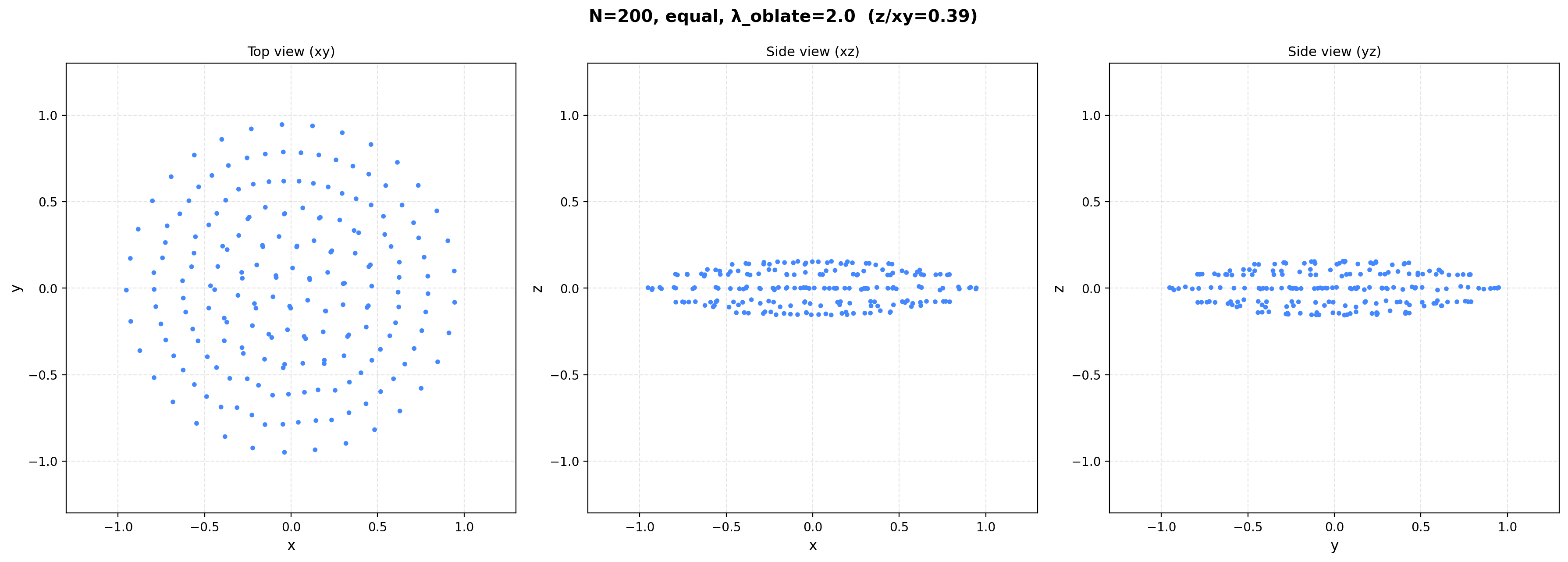
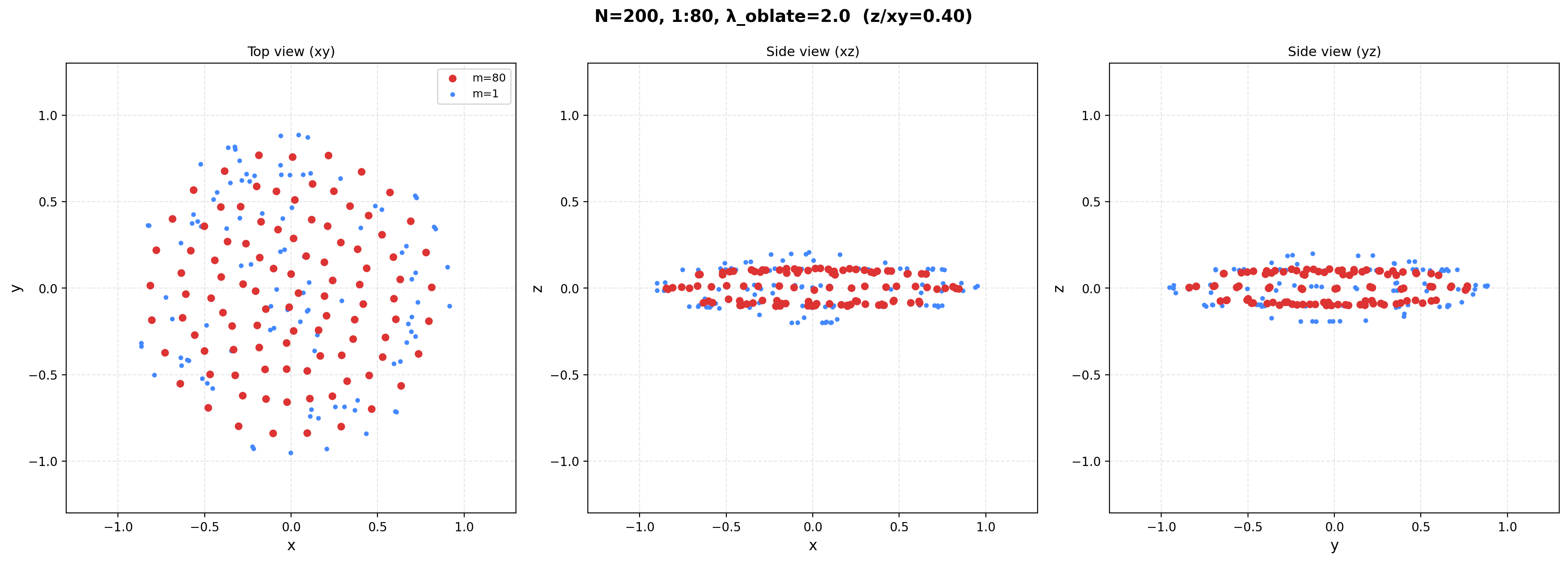
| Top view | Projection onto the in-plane directions. If the shape is oblate, this is where the full spread remains visible. |
| Side views | Projections onto planes containing the emergent axis. Flattening shows up here first. |
| Aspect | Reported as the ratio of the smallest to largest principal scale. Aspect near 1 means nearly spherical. Smaller aspect means flatter, more oblate. |
| α | Weight of the pairwise electric-like term. |
| β | Weight of the triangle-based magnetic-like term. |
Maria's Functional by Itself
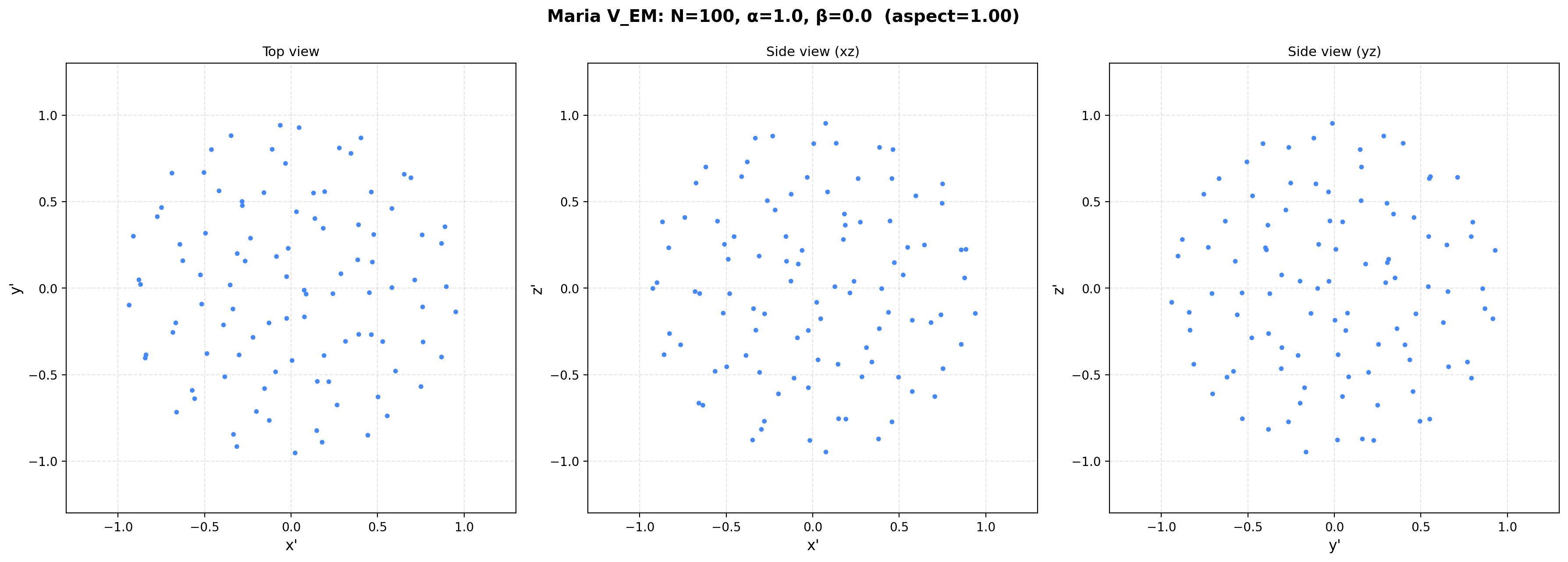
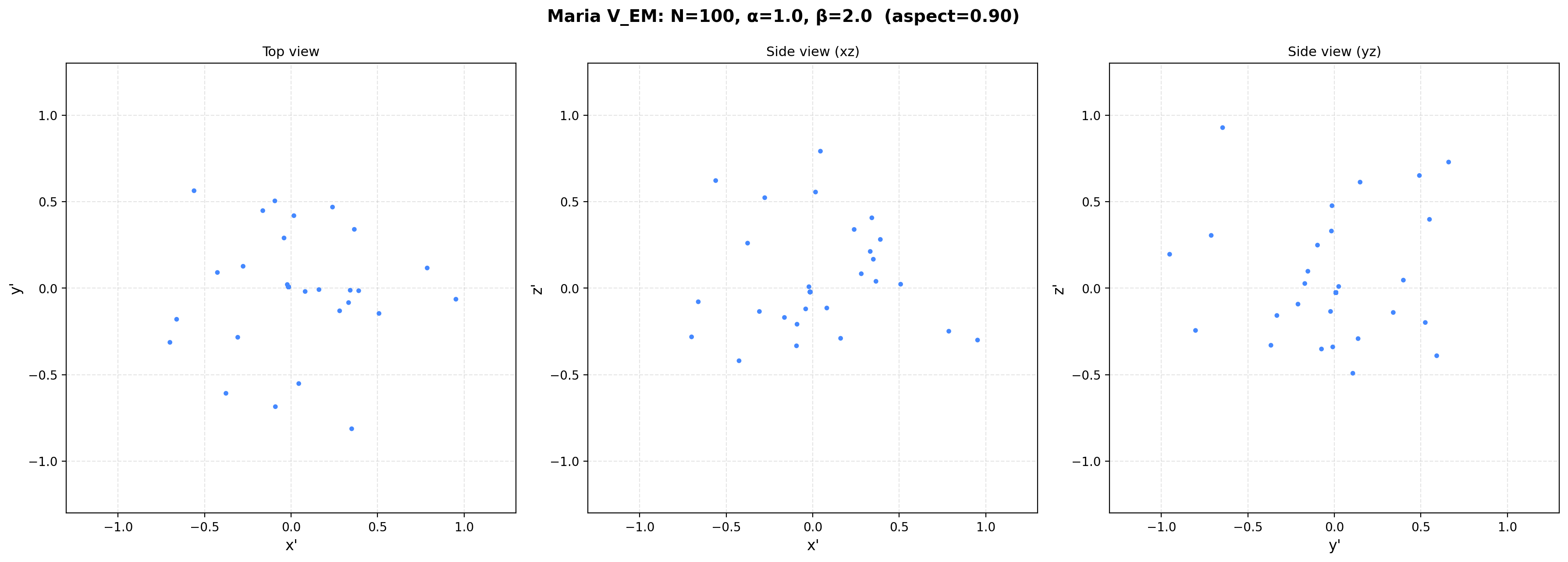
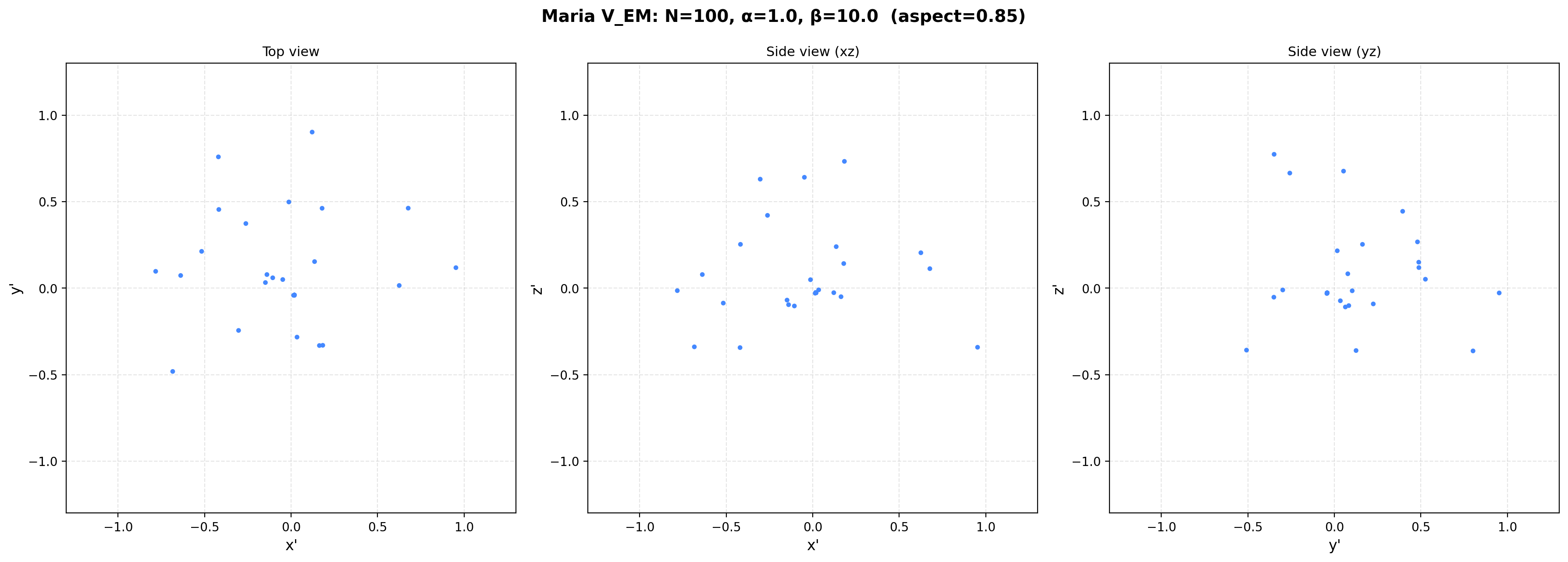
These three figures keep α = 1 fixed and vary
β. In the current implementation all charges are
+1 and all masses are equal. The only question being tested is:
does the triangle term create an emergent flattening axis?
What we understand from these three figures:
Maria's triangle term does not merely perturb the pairwise solution. It creates a self-organised preferred axis and drives the minimiser away from spherical symmetry.
Our Controlled Extension
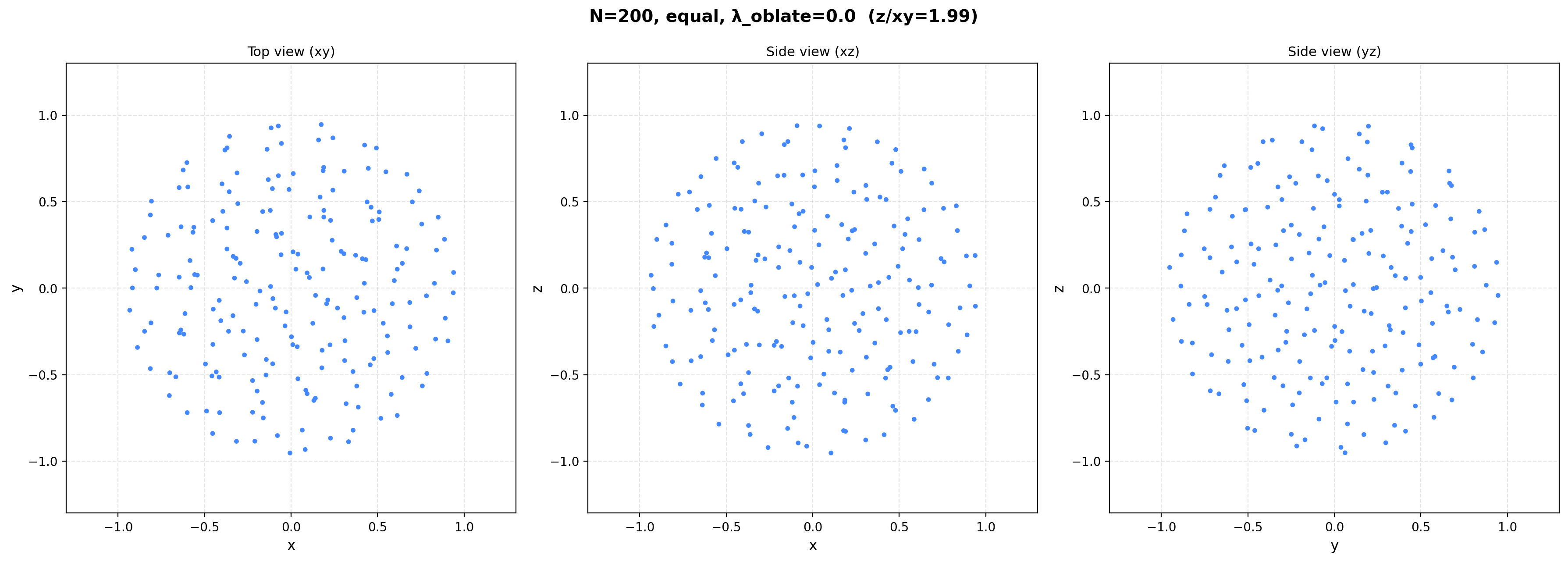
We also tested a cheaper proxy that does not reproduce Maria's full
VEM term, but asks the same qualitative question:
can an orientation-sensitive correction flatten the configuration into a Jupiter/Saturn-like oblate shape?
Voblate = VS (1 + λoblate Aoblate)
This proxy is not a replacement for Maria's functional. It is a controlled extension:
lower cost, easier sweeps, same geometric target.
What This Shows
| Claim | Status |
|---|
| Maria's triangle term can generate an emergent axis | Shown |
| Increasing β produces stronger oblateness in the current equal-charge tests | Shown |
| A cheaper oblate proxy reproduces the same qualitative flattening target | Shown |
| The proxy is mathematically equivalent to Maria's full triangle term | Not claimed |
| Charge heterogeneity changes the resulting oblate families in an interpretable way | Not yet tested here |
| Maria's functional yields molecule-like local motifs and global oblateness simultaneously | Open |
Best Next Extensions
- β sweep at fixed N: map aspect ratio against the magnetic coefficient and identify where oblateness first appears.
- Charge patterns: move beyond all-ones charges and test whether sign structure changes the emergent axis or local clustering.
- Mass-ratio comparison: hold α and β fixed while varying masses, to see whether gravitational-molecule motifs survive under the electromagnetic extension.
- Proxy vs full functional: compare the cheap oblate proxy to Maria's full VEM at matched flattening, so the extension reads as controlled rather than ad hoc.
The right narrative for the site:
First show that Maria's functional is understood on its own terms.
Then show one extension that preserves the geometric question while making larger exploratory sweeps feasible.