Central Configurations of 100-Body Systems
Shape Dynamics — Barbour's Variety Functional
How to Read This Site
1. Start with the minimum. Near Vmin,
configurations are close to uniform packing.
2. Then move upward in age. Higher age means larger
V - Vmin, hence more visible structure:
clusters, filaments, voids, and local motifs.
3. Compare mass ratios. Equal masses test pure packing.
Unequal masses test how the same scale-invariant functional reorganises local structure.
The Variety
Given N particles with positions
ri, define the root-mean-square
and mean-harmonic-length of all pairwise separations
rij = |ri − rj|:
ℓrms = √(Σ rij²)
ℓmhl = 1 / Σ(1/rij)
The Variety is their ratio:
V = ℓrms / ℓmhl
V is purely geometric, scale-invariant, and dimensionless.
It measures how far a configuration departs from uniformity.
Masses affect only the centre-of-mass weighting, not V itself.
Critical Points
Central configurations are all critical points of
V — minima, saddle points, and maxima.
Minima of V are always
uniform or hexagonally-packed arrangements. Mathematically interesting,
visually unremarkable.
Saddle points produce the visually striking configurations:
filaments, clusters, voids, and hierarchical structure. These sit
1–100% above Vmin.
Age
Age = (V − Vmin) / Vmin × 100%
A timeless complexity label. Age = 0 at the minimum (maximum uniformity).
Higher age means more structure. For N = 100, Vmin ≈ 522,312.
Maria's Electromagnetic Extension
Maria's new functional keeps the scale-invariant logic but adds an
orientation-sensitive three-body term. Pairwise separations supply the
electric-like part. Oriented triangles supply the magnetic-like part.
Instructional summary:
Pairs control radial structure.
Triangles create an emergent axis through their total oriented area.
The magnetic coefficient β controls how strongly the configuration
flattens around that self-generated axis.
Maria's VEM explained
Baseline, mechanism, and a controlled extension to oblate Jupiter/Saturn-like shapes.
6 figures: Maria's functional alone, then our oblate proxy side by side
This page is meant to read as a mechanism, not just a result:
what the pair term does, what the triangle term does, how to read the side views,
and what our extension changes.
Interesting Shapes (High Age)
These are saddle-point configurations with age ≥ 5% — shapes
with visible structure: filaments, clusters, voids.
Variety, mass ratio 1:2000 — Interesting shapes
40 configurations with age ≥ 5%. One heavy body among 99 light ones.
Range: 5.3% to 97.5% above Vmin
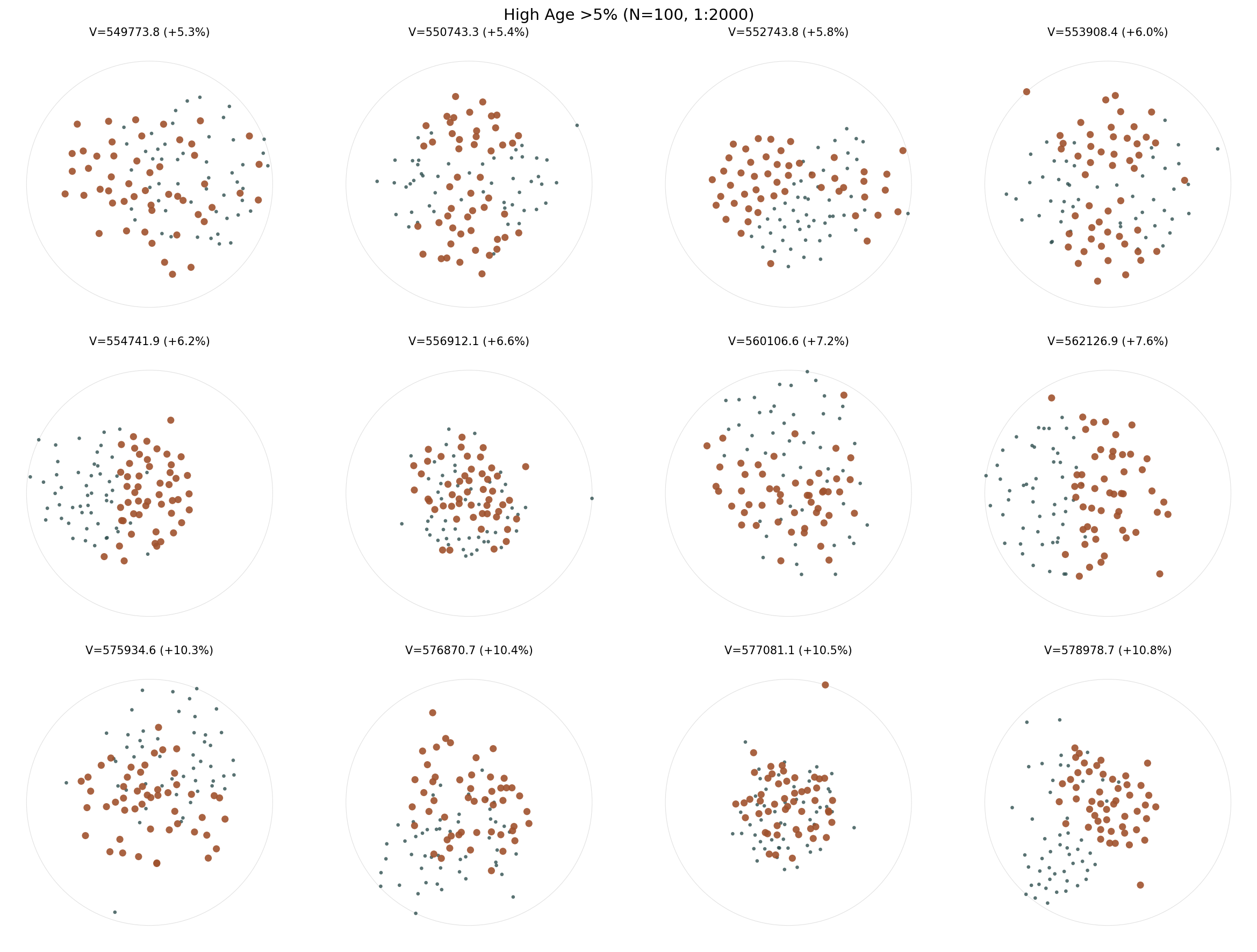
Representative high-age configurations (1:2000 mass ratio)
Variety, equal masses — Interesting shapes
34 configurations with age ≥ 5%. All 100 bodies have equal mass.
Range: 5.0% to 107.1% above Vmin
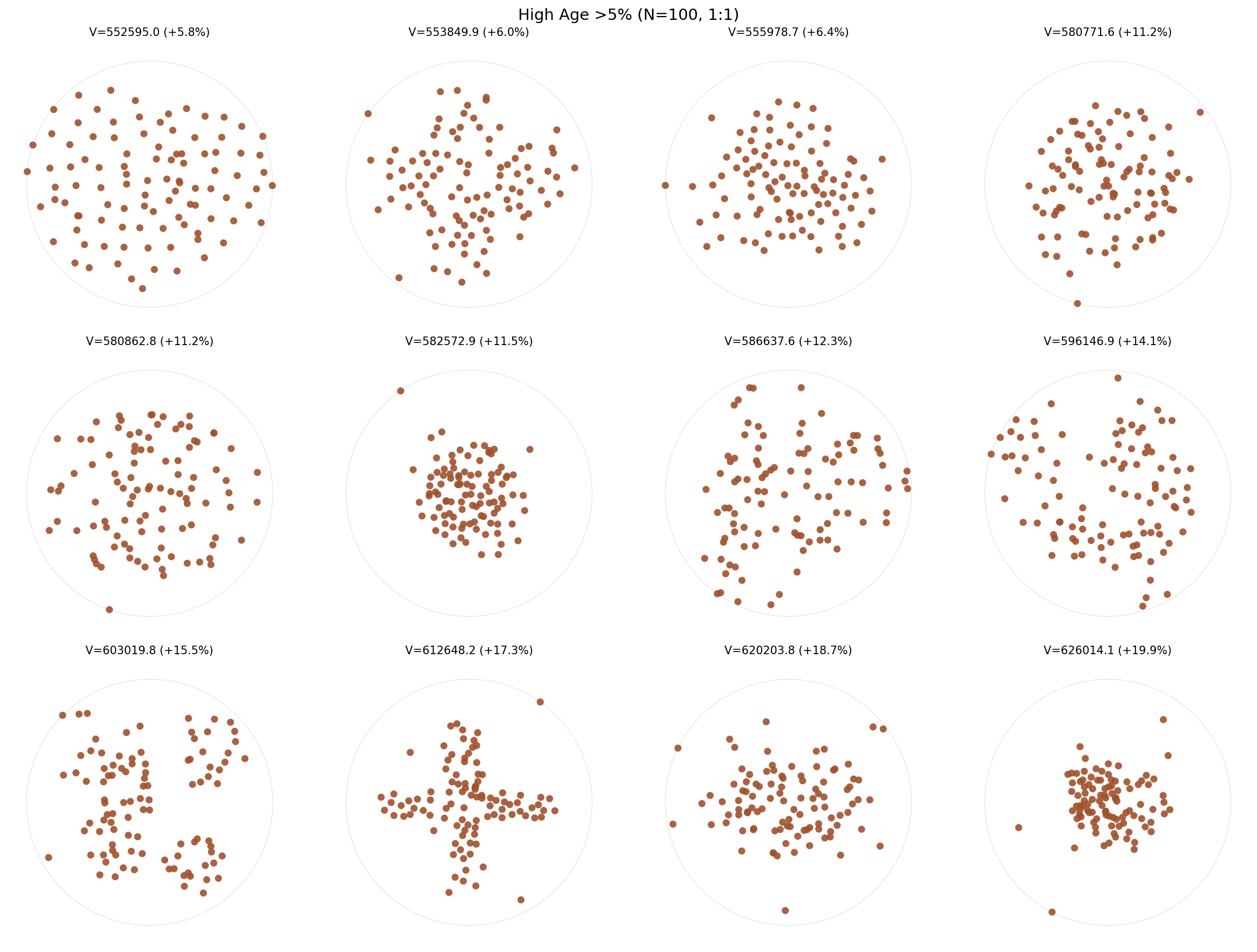
Representative high-age configurations (equal masses)
All 500 Configurations
The complete set of optimised configurations from each search.
Most land near Vmin (uniform packing). The interesting
shapes above were drawn from these.
Variety, mass ratio 1:2000 — All 500
Full set. 500 gradient-optimised configurations, sorted by age.
40 with age ≥ 5%, 460 near-minimum
Variety, equal masses — All 500
Full set. 500 gradient-optimised configurations, sorted by age.
34 with age ≥ 5%, 466 near-minimum
Method
| Parameter | Value |
|---|
| N (particles) | 100 |
| Functional | V = ℓrms / ℓmhl |
| Optimiser | L-BFGS via JAX autodiff |
| Attempts per dataset | 500 |
| Initialisation strategies | Clustered, ring, line, cross, random |
| Vmin (N=100) | ≈ 522,312 |
Diverse initialisation is key. From uniform starts, >90% of optimisations
land at the global minimum. Structured initialisations (ring, cross, clustered)
access saddle-point basins that produce high-age configurations.